
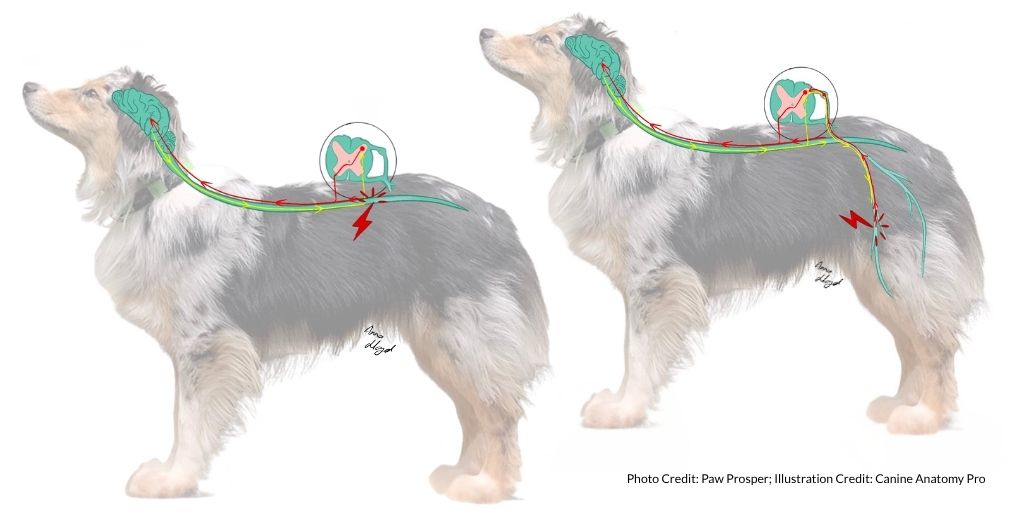
Pain is one of the most common reasons our patients are referred for rehabilitation. Yet, despite being central to everything we do, the language surrounding pain has become increasingly complex. Nociception. Nociceptive pain. Neuropathic pain. Nociplastic pain. Peripheral sensitisation. Central sensitisation. Hyperalgesia. Allodynia.
For many rehabilitation professionals, these terms can feel like pieces of a puzzle that never quite fit together. We recognise them individually, but understanding how they relate to one another – and how they influence our clinical reasoning – is often less straightforward.
Fortunately, the goal isn’t to memorise a growing list of definitions. Instead, these terms provide a framework for understanding where pain originates, how it is processed, and why two patients with seemingly similar injuries can have completely different pain experiences.
Let’s start at the beginning.
Pain Begins with Nociception… But Nociception is Not Pain
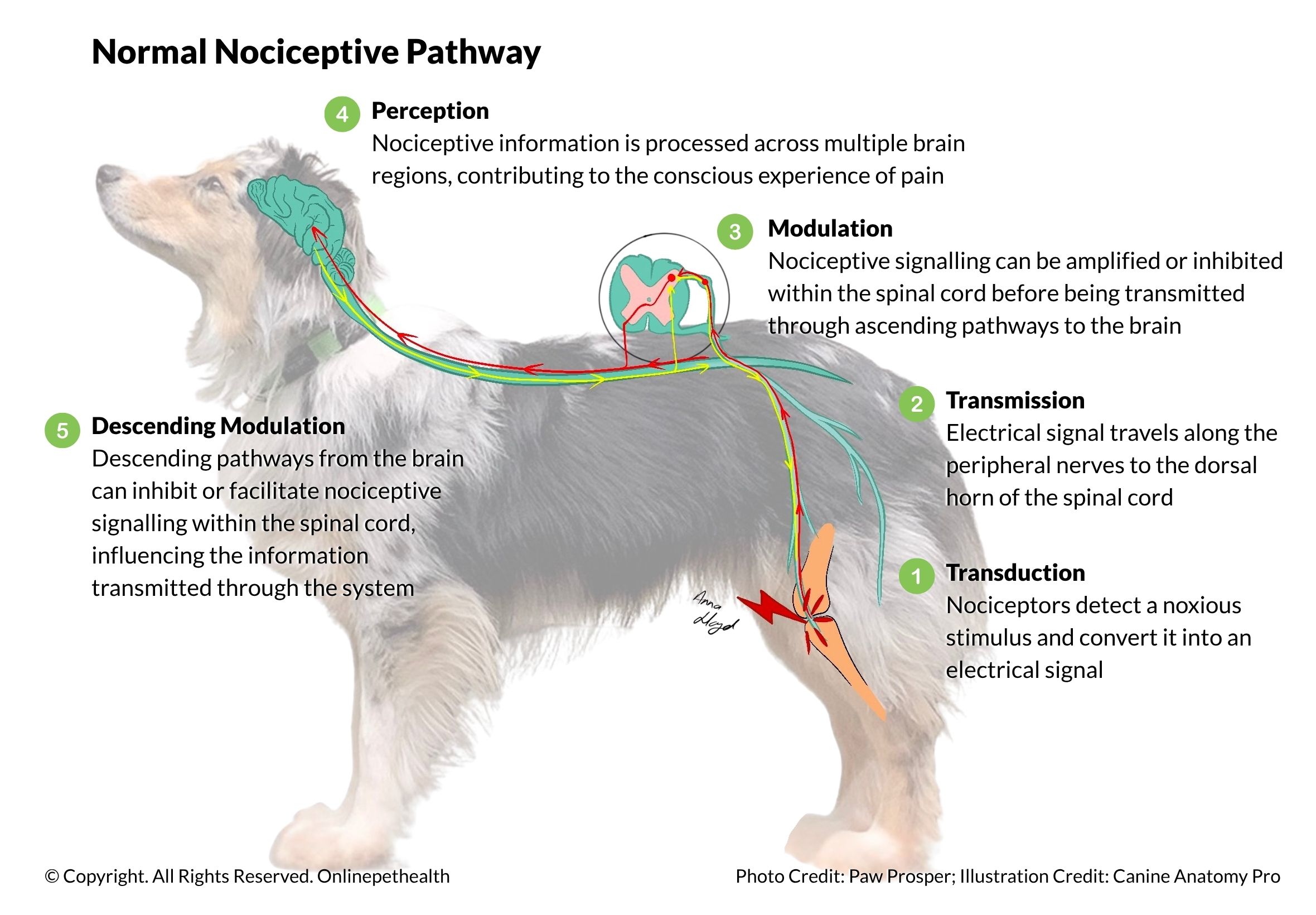
When a dog lands awkwardly after chasing a ball or a horse strains a suspensory ligament, tissue damage may occur, resulting in the release of inflammatory mediators. Specialised sensory receptors called nociceptors detect potentially harmful mechanical, thermal or chemical stimuli.
The neural process of encoding and processing these noxious stimuli is known as nociception.
Nociceptors convert noxious stimuli into electrical signals that travel along peripheral nerves to the spinal cord before continuing to the brain. Incoming nociceptive information can be modified through amplification or inhibition within the spinal cord before being processed across multiple regions of the brain. The brain interprets this information within the context of past experiences, the current environment, emotional state and many other factors, contributing to whether pain is experienced and the nature and intensity of that experience.
One of the most important concepts in modern pain science is this:
Nociception is not pain.
Nociception is the neural process of encoding noxious stimuli, whereas pain is currently defined by the International Association for the Study of Pain (IASP) as “an unpleasant sensory and emotional experience associated with, or resembling that associated with, actual or potential tissue damage.”
Importantly, pain and nociception are different phenomena, and pain cannot be inferred solely from activity in sensory neurons.
Pain is therefore an experience arising from processing within the nervous system, not simply a signal travelling from the tissues to the brain.
This distinction helps explain why similar injuries can produce very different pain experiences, why pain sometimes persists long after tissues have healed, and why pain can occur even when no obvious tissue damage is present.
Different Ways of Describing Pain
One reason pain terminology becomes confusing is that we often use different classification systems interchangeably.
Sometimes we describe pain according to how long it has been present:
- Acute pain
- Chronic pain
Sometimes we describe where it originates:
- Somatic pain
- Visceral pain
Increasingly, however, rehabilitation professionals are encouraged to think about pain according to the underlying mechanisms contributing to it.
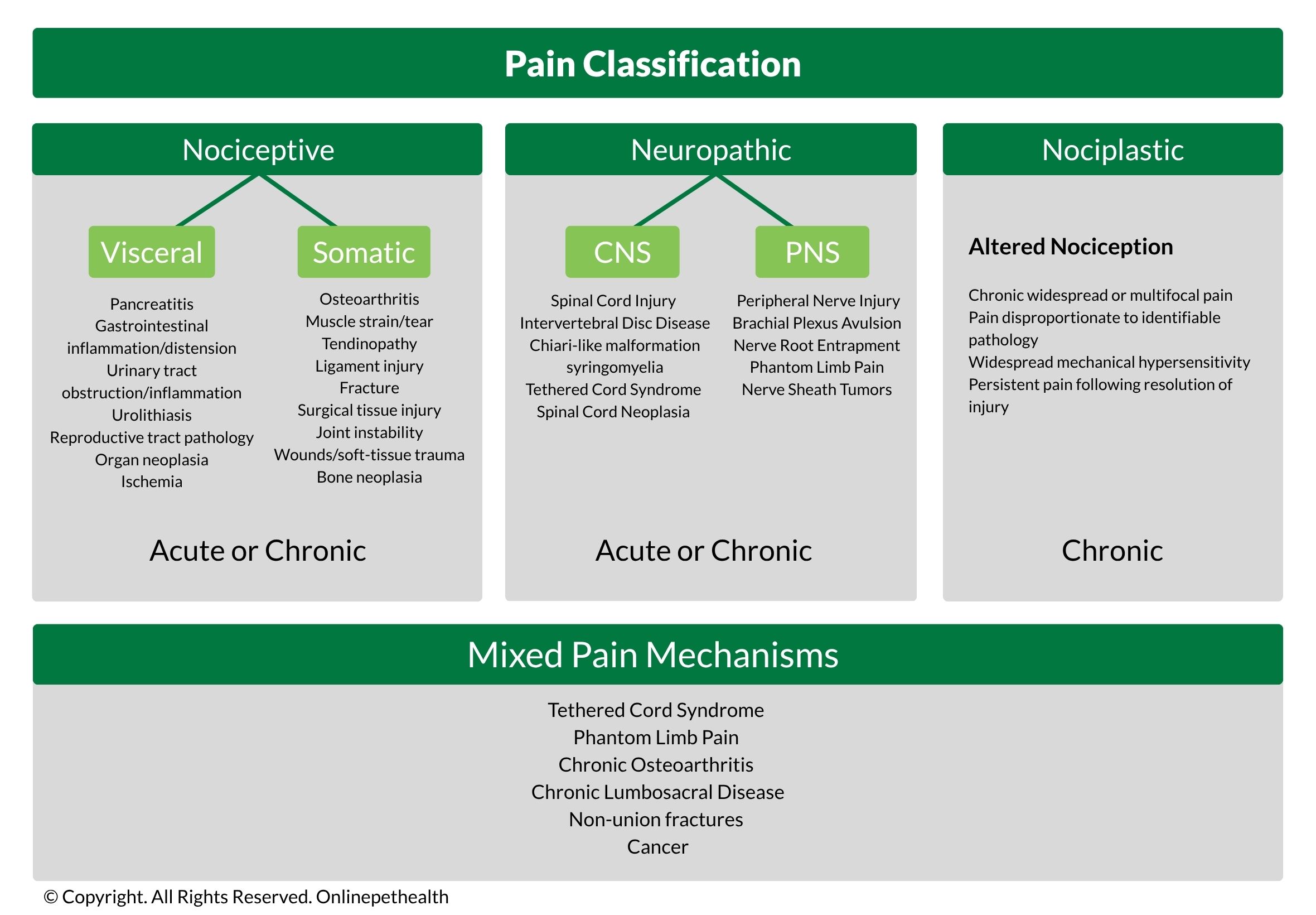
Three mechanistic descriptors – nociceptive, neuropathic and nociplastic pain – provide a useful framework for understanding modern pain science.
Three Mechanisms That Can Drive Pain
Although the pain experience ultimately emerges through processing within the nervous system, the biological processes contributing to that experience can begin in different places.
Rather than thinking of these as different types of patients, it can be helpful to think of them as different mechanisms that may contribute to an individual patient’s pain experience.
Nociceptive Pain
Nociceptive pain occurs when nociceptors respond to actual or threatened damage to the musculoskeletal systems.
This is the protective pain most Vetrehabbers are familiar with. Tissue injury, inflammation, excessive mechanical loading or surgery can activate nociceptors, sending signals through an otherwise normally functioning somatosensory nervous system.
Examples in rehabilitation include:
- Muscle strains
- Ligament sprains
- Fractures
- Post-operative pain
Nociceptive pain is generally related to the extent and nature of tissue injury and should gradually improve as healing progresses and the nociceptive driver resolves.
Neuropathic Pain
Neuropathic pain occurs when there is a lesion or disease affecting the somatosensory nervous system itself, either peripherally or centrally.
Rather than nociceptors responding to threatened or actual damage in non-neural tissues, the lesion or disease within the somatosensory nervous system itself contributes to the pain experience.
Examples include:
- Traumatic peripheral nerve injuries like a brachial plexus avulsion
- Trigeminal neuralgia
- Nerve root compression or entrapment
- Phantom limb pain following an amputation
- Nerve sheath tumours
- Spinal cord injury
- Stroke
- Tethered Cord Syndrome
Neuropathic pain may be acute or chronic and can coexist with nociceptive and nociplastic mechanisms.
Patients with neuropathic pain often describe sensations such as burning, shooting, electric or tingling in human medicine, although recognising comparable characteristics in veterinary patients requires careful observation of behaviour, sensory abnormalities and clinical presentation.
Nociplastic Pain
Nociplastic pain is perhaps the newest – and often most misunderstood – mechanistic descriptor.
The IASP defines nociplastic pain as pain arising from altered nociception, despite there being no clear evidence of actual or threatened tissue damage causing activation of peripheral nociceptors, or evidence of disease or lesion of the somatosensory system, sufficient to explain the pain.
Nociplastic pain is associated with changes in the way nociceptive information is processed. Peripheral and/or central sensitisation are commonly present, although neither is specific to nociplastic pain, and the mechanisms responsible for altered nociception are still being investigated.
This does not mean the pain is imagined or psychological. The pain experience is very real, but its magnitude, distribution or persistence cannot be adequately explained by ongoing tissue damage or a lesion of the somatosensory nervous system alone.
As our understanding of chronic pain evolves, nociplastic mechanisms are becoming increasingly recognised in human pain science, while their identification and clinical relevance in veterinary patients remain an emerging area.
Where Does Sensitisation Fit?
One of the biggest sources of confusion is where peripheral and central sensitisation belong.
Importantly, sensitisation is not a separate pain mechanism.
Instead, sensitisation describes changes within the nervous system that increase its responsiveness to incoming stimuli.
These changes can contribute to nociceptive, neuropathic and nociplastic pain.
Peripheral Sensitisation
Peripheral sensitisation occurs at the site of tissue injury or inflammation. Inflammatory mediators released in response to tissue damage alter the properties of peripheral nociceptors, reducing their activation threshold and increasing their responsiveness to stimulation. This creates an initially protective and adaptive response: injured tissues become more sensitive, encouraging the animal to protect the area while healing occurs.
As a result, a stimulus that previously produced a small nociceptive response may now produce a much larger one. This increased peripheral input can contribute to pain hypersensitivity around the injured area and, when sustained, can also drive changes further along the nociceptive pathway.
Central Sensitisation
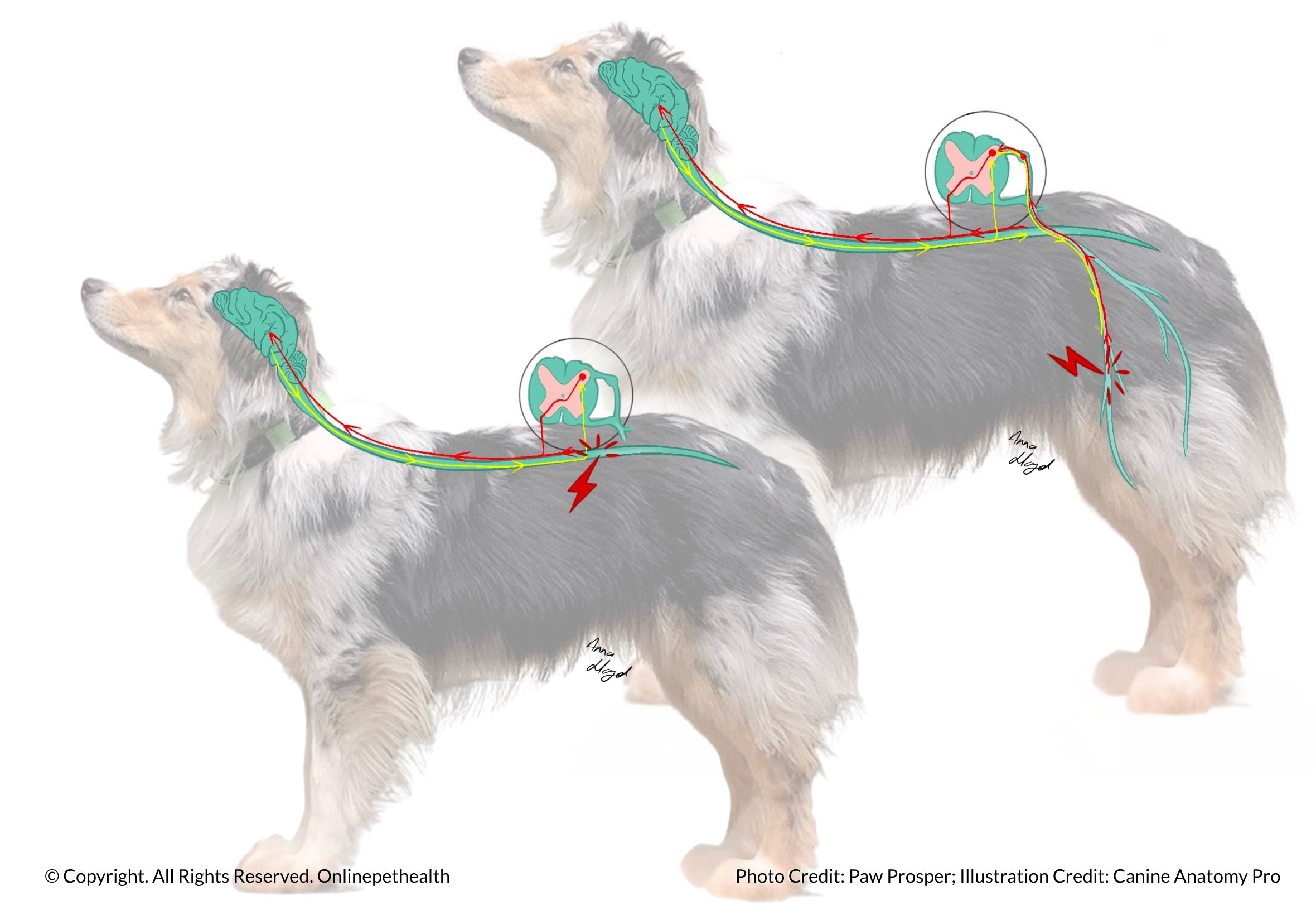
When increased nociceptive input repeatedly reaches the spinal cord – as may occur with ongoing inflammation, tissue injury or damage to peripheral nerves – the central nervous system can begin to adapt.
Repeated activation of nociceptive pathways increases excitatory neurotransmission within the dorsal horn of the spinal cord. NMDA receptors become increasingly involved, synaptic connections strengthen and neurons become more excitable. At the same time, inhibitory mechanisms that would normally dampen nociceptive information may become less effective. Glial cells and neuroinflammatory processes can further influence this changing neural environment.
In other words, the CNS undergoes neuroplastic change.
The result is an amplification of nociceptive processing: central neurons may respond more strongly to their normal inputs, begin responding to inputs that were previously below threshold, and develop larger receptive fields. Importantly, the relationship between the original peripheral stimulus and the resulting response becomes less predictable.
What Does Sensitisation Look Like Clinically?
As you explore pain science, you’ll likely come across additional terminology that describes phenomena associated with altered nociceptive processing.
Hyperalgesia is an increased pain response to a stimulus that would normally be painful.
Allodynia is pain in response to a stimulus that would not normally provoke pain, such as light touch.
Temporal summation describes the progressively increasing pain experience that can occur when an identical noxious stimulus is repeatedly applied.
Wind-up is related, but importantly isn’t synonymous with temporal summation or central sensitisation. It describes a frequency-dependent increase in the firing of dorsal horn neurons following repeated C-fibre stimulation and is one experimental mechanism that has helped us understand how central excitability can increase. NMDA receptor activation plays an important role in this process.
Descending modulation describes pathways originating higher within the CNS that can either inhibit or facilitate nociceptive processing at the spinal level. Changes in the balance between descending inhibition and facilitation may therefore further influence how much nociceptive information ultimately contributes to the pain experience.
These changes help us understand why, in some patients, pain can spread beyond the original area of injury, become disproportionate to the apparent tissue damage, or persist even as the original tissues heal. The nervous system is no longer simply transmitting information about the tissues. It has adapted in response to that information.
Conclusion
Modern pain science has introduced a wealth of new terminology, but these concepts become far less intimidating once we understand how they fit together.
Pain and nociception are not synonymous. Pain may arise through nociceptive, neuropathic or nociplastic mechanisms, while peripheral and central sensitisation describe changes within the nervous system that can alter and amplify nociceptive processing.
Understanding this framework allows us to move beyond simply asking where pain is coming from and instead begin asking why our patients are experiencing pain in the way they do.

Continue Learning
Watch the following webinars in the Onlinepethealth Members Libraries to keep learning about pain and how we can address it as veterinary rehabilitation therapists:
- Understanding and Managing Neuropathic Pain in Small Animal Rehabilitation Patients, Kara Amstutz
- More Than Nociception: Rethinking Chronic Pain in Dogs, Ansi van der Walt
- What Kind of Pain Is This?, Ansi van der Walt
- Matching Treatment to Mechanism, Ansi van der Walt
- The Nociplastic Dog, Ansi van der Walt
- Pain Physiology, Kenneth Joubert
- Chronic Pain Management, Kenneth Joubert
- Acute Pain Management, Kenneth Joubert
- Local Anaesthesia, Kenneth Joubert








0 Comments